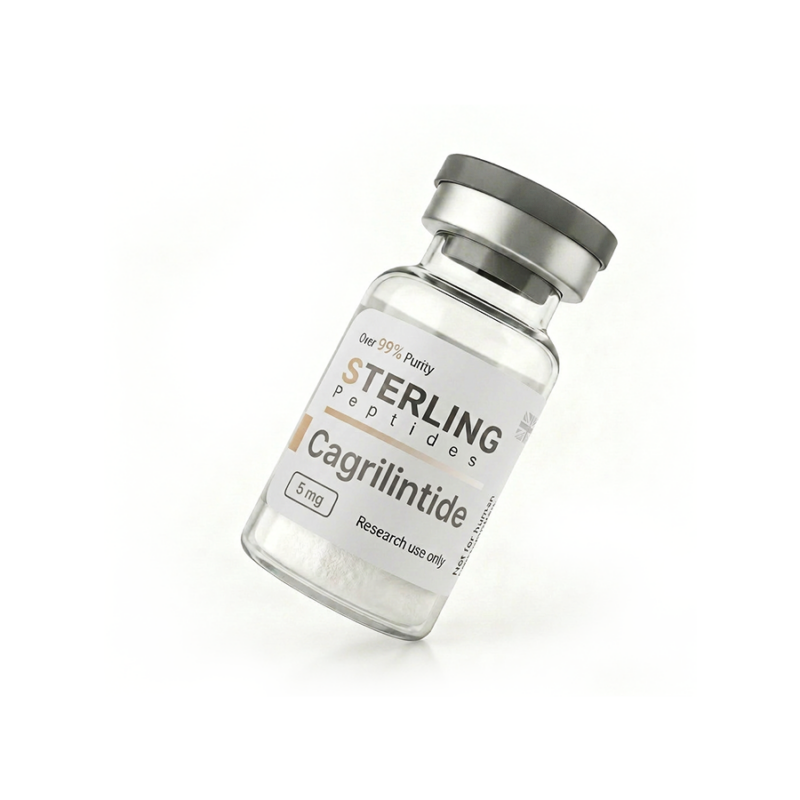
Description
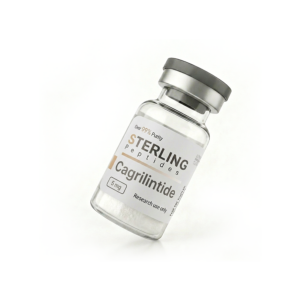
Cagrilintide research peptide
Cagrilintide is a synthetic, long-acting analogue of amylin, a 37-amino-acid peptide hormone co-secreted with insulin. An N-terminal C20 fatty diacid side chain promotes reversible albumin binding, which extends its half-life compared with native amylin. It acts as an agonist of the amylin receptors (AMYR) and the calcitonin receptor (CTR), and is studied in vitro in research on amylin signalling and metabolic pathways.
Supplied as a lyophilised powder in 5mg and 10mg vials. Cagrilintide is an investigational compound and is not a licensed medicine in the UK. We supply it strictly as a research reagent.
Specifications
| Name | Cagrilintide (AM833) |
|---|---|
| Class | Acylated amylin analogue, 37 amino acids, C-terminal amide |
| Structure | Cys2–Cys7 disulphide bridge; N-terminal eicosanedioic acid via γ-Glu linker |
| Molecular formula | C194H312N54O59S2 |
| Molecular weight | ≈ 4409.0 g/mol |
| CAS number | 1415456-99-3 |
| Form | White to off-white lyophilised powder in a sealed glass vial |
| Sizes | 5mg · 10mg |
Where cagrilintide fits in research
Quality and testing
Read more about our process on the Quality & Testing page.
Storage and handling
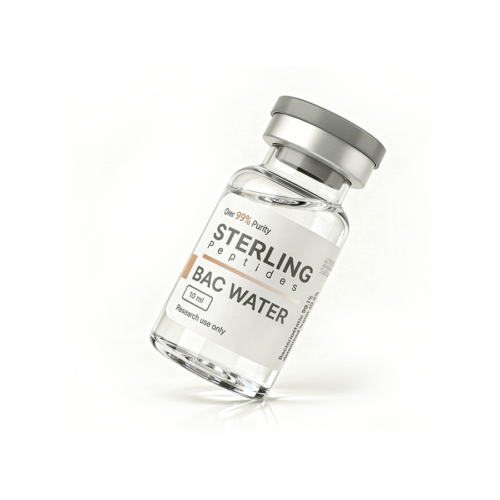
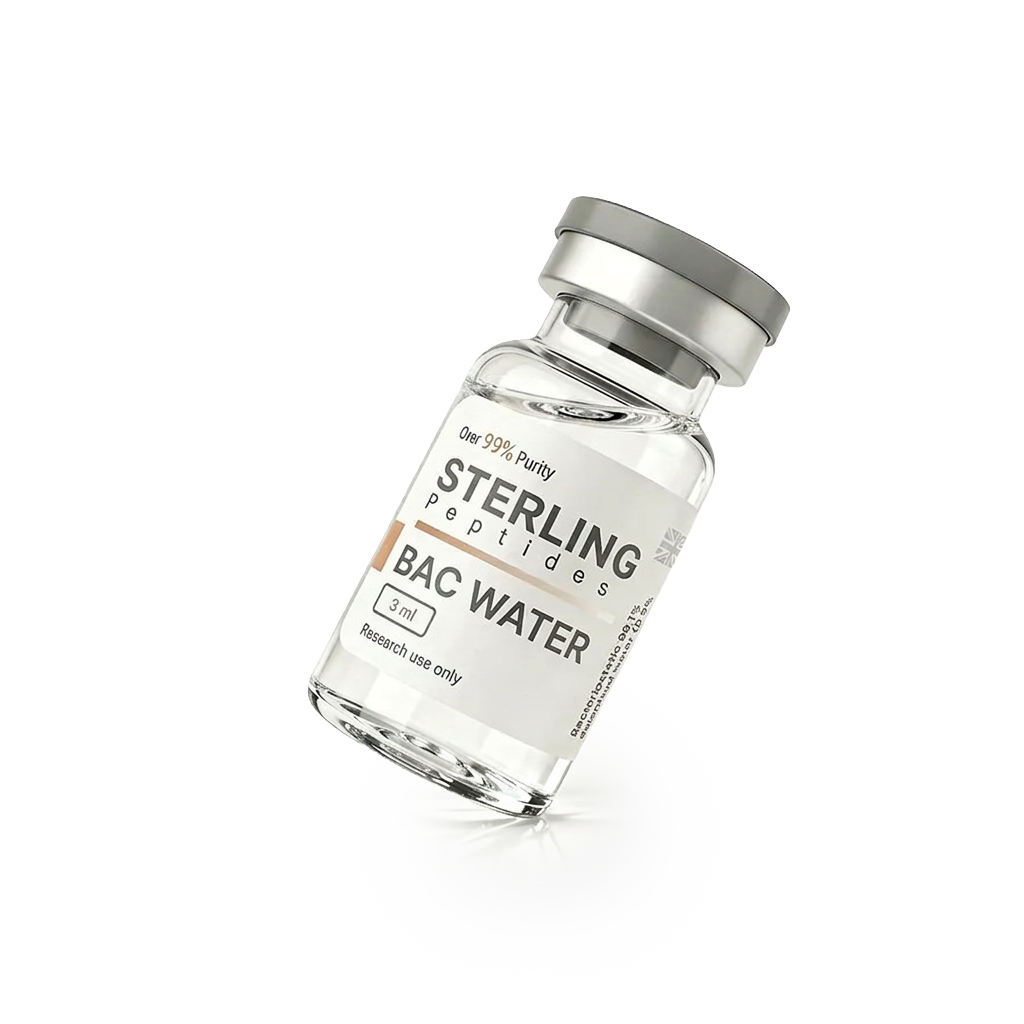
Store the lyophilised powder at −20 °C, sealed and protected from light and moisture. Allow the vial to reach room temperature before opening to limit condensation. Lipidated peptides can adsorb to plastics, so low-binding labware is often used. Prepare solutions according to your laboratory’s validated protocols, using appropriate PPE. Bacteriostatic water is available separately for laboratory use.
Frequently asked questions
What is cagrilintide?
Cagrilintide is a synthetic, long-acting analogue of amylin, a peptide hormone co-secreted with insulin. It carries a C20 fatty diacid side chain that promotes albumin binding and extends its half-life. It is studied in vitro in research on amylin and calcitonin receptor signalling.
Is cagrilintide a GLP-1 agonist?
No. Cagrilintide acts on amylin receptors (AMYR) and the calcitonin receptor (CTR), not the GLP-1 receptor. Because the two pathways are different, amylin analogues are often studied alongside incretin-based compounds such as tirzepatide and retatrutide.
What sizes is cagrilintide available in?
Cagrilintide is available in 5mg and 10mg lyophilised research vials. Choose the size from the options above.
What is the structure of cagrilintide?
Cagrilintide is a 37-amino-acid amidated peptide based on the amylin sequence, with a disulphide bridge between Cys2 and Cys7 and an N-terminal lipid side chain (eicosanedioic acid linked via γ-Glu). Its molecular formula is C194H312N54O59S2, with a molecular weight of about 4409.0 g/mol.
Is cagrilintide licensed in the UK?
No. Cagrilintide is an investigational compound and is not a licensed medicine in the UK. We supply it strictly as a research reagent for in vitro laboratory work.
What purity is your cagrilintide?
Every batch is purity tested by Janoshik, an independent laboratory, using HPLC before it is released for sale.
How should cagrilintide be stored?
Store the lyophilised powder sealed at −20 °C, protected from light and moisture. Allow the vial to reach room temperature before opening. Lipidated peptides can adsorb to plastics, so low-binding labware is often used. Stability in solution should be validated within your own laboratory protocol.
Do you ship cagrilintide from the UK?
Yes. Orders placed before 3PM UK time, Monday to Friday, are normally dispatched the same day by Royal Mail Tracked 24. See our Shipping Policy.
Do you provide dosing or usage advice?
No. Cagrilintide is supplied for in vitro laboratory research only. We do not provide dosage, administration or medical advice of any kind.
Research use only. This product is supplied strictly for in vitro laboratory research. It is not for human or animal use, and not for diagnostic or therapeutic purposes. By purchasing, you agree to our Research Use Disclaimer.